
The Disclaimer Reflex
On the quiet price of playing it safe
I am not someone who avoids things. I show up. I do the work. I say what I mean, mostly. But I’ve also been noticing a habit I can’t fully explain away. This tendency to preface things. To lead with this may have already been brought up, or to slow down before stating a strong opinion, as if I owe the room a disclaimer before I’m allowed to take up space in it.
I used to think this was just manners.
There is a peculiar kind of courage that gets mistaken for shamelessness. You see it at the podium, in the open-plan office, across the dinner table when a person speaks first, when they hold the floor, and seems constitutionally unbothered by the risk of being wrong in public. We watch them with a mixture of irritation and envy, and we tell ourselves there must be something wrong with them, that their ease is a symptom of some deficit we’d rather not name.
We have built a very convincing philosophy around going inward. Know thyself. The unexamined life isn’t worth living. Happiness comes from within. These ideas have been with us so long that they feel like facts now. And they’re not wrong, exactly. But they’ve been stretched into something that conveniently lets us stay inside our own heads, to refine the thought one more time before we say it, and to keep waiting until we’re sure before we commit to being sure.
We have convinced ourselves that the people most deserving of our respect are the ones in permanent consultation with their inner life, forever auditing, forever adjusting, forever slightly wincing. Confidence, in this moral economy, is almost suspicious. Too clean. After all, someone who doesn’t seem to be suffering must not be paying attention.
I know I have spent a lot of time inside my own head. More than is probably useful. Reading, thinking, writing things down in notebooks I rarely go back to. I always thought of this as a virtue and I have explained it as the slow careful work of knowing myself. I still think it has value. But I’ve started to suspect I’ve been using it wrong. Because somewhere along the way, the inner life became a place to hide.
But here is the thing about always staying inside your own head: it is extraordinarily expensive. And we have been paying it quietly by calling it depth.
The research doesn’t support any of this. Decades of wellbeing science keeps pointing outward. Happiness does not, in fact, come from within. Or not primarily. It comes from other people, from action, from the specific friction of being in the world and sometimes being wrong about something in front of witnesses. The inner life isn’t the source of flourishing. It’s where you go to prepare for it. And preparation is only useful if you eventually show up.
The Buddhist meditator and the Stoic philosopher and the Romantic poet all made the same error. They mistook the rehearsal for the performance.
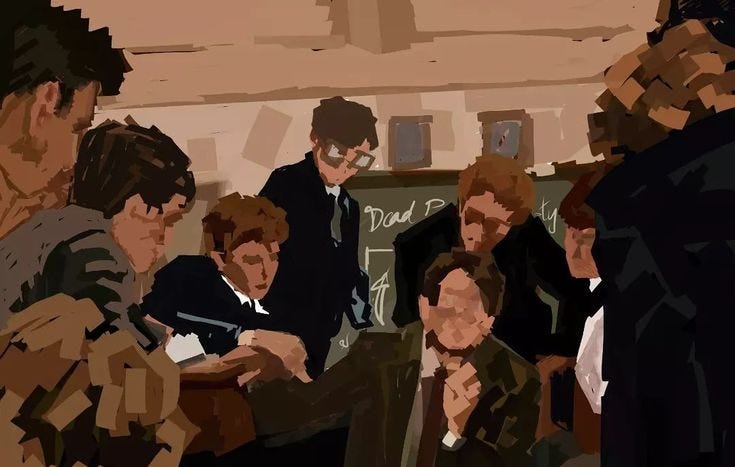
John Keating (from the Dead Poets Society) understood this, which is what made him dangerous. He stood on his desk not to be seen, but to show his students what seeing differently required. It was the willingness to look foolish, to be conspicuous, to let the body make the argument when words had become inadequate. Oh captain, my captain. The line works because it costs something to say it.
There’s a question I keep coming back to, one I heard put simply, at some point, isn’t life about getting to where that doesn’t affect you? Not indifference. Not the performance of someone who’s stopped listening. But the ability to put a thought in the room before you’ve fully armoured it. To finish your sentence. To disagree without first building an exit for yourself.
Most of us were never taught to do this. We were taught the opposite. To preface. To soften. To make the position small enough that being wrong about it wouldn’t cost much. And we called that thoughtfulness, or humility, or self-awareness, because those are better words for it than what it actually is.
Shame is invisible infrastructure. You don’t notice how much of your behaviour is organizing around shame until you try to do something without it. Then you feel it. You feel the pull to qualify, to let someone else go first, to stay legible and unrisky and inoffensive. It doesn’t feel like fear. It feels like consideration. This is why we have breed a whole generation that won’t do and say as they please because they are afraid of being cringe or to be seen trying. We used to call that kind of self-consciousness adolescence. Now it’s just a regular Tuesday.
Don’t get me wrong, I’m not interested in the version of confidence that’s just volume. And I don’t think shamelessness is a virtue on its own. There is a version of it that is genuinely ugly, that is all aggression with no reflection. But I think we’ve got the balance wrong in the other direction. We’ve mistaken the rehearsal for the life. We keep turning inward to prepare, and we never quite feel prepared enough.
Solitude is not overrated. Introspection is not nothing. But we have confused the map for the territory. Somewhere we started believing that the most authentic version of a person was the one they kept to themselves, polished and uncontested, never risked in contact with the world. But a self that is never spent in public is not a treasure. It is a hoard.
So put yourself out there. I guarantee you at some point, it will stop affecting you. Not because you’ve stopped caring, but because you’ve stopped treating your own discomfort as the most important thing in the room. Not because you have no shame, but because you have decided that shame is a tax, and you are no longer willing to pay it for every idea you put into the world.
So stand on the desk. Say the thing you’ve been turning over for weeks. Let it be imperfect in public. That’s not recklessness. That’s just the difference between a life that happened and one you kept meaning to start.
So stand on the desk. It's just a desk.
Thank you for bringing out this. Just started this stack to read your masterpieces. This one is so powerful way to put into perspectives. I am guilty of not being too cringe or embarrassed enough to initiate many things in public. It reminded me of the African proverb- ‘The best time to plant the tree is yesterday and better time is today’. If not done now, when? Perhaps, many people do not think and care about us as much as we overthink they would. Other’s judgement may be undesirable but one can decide to control about how to take it forward.